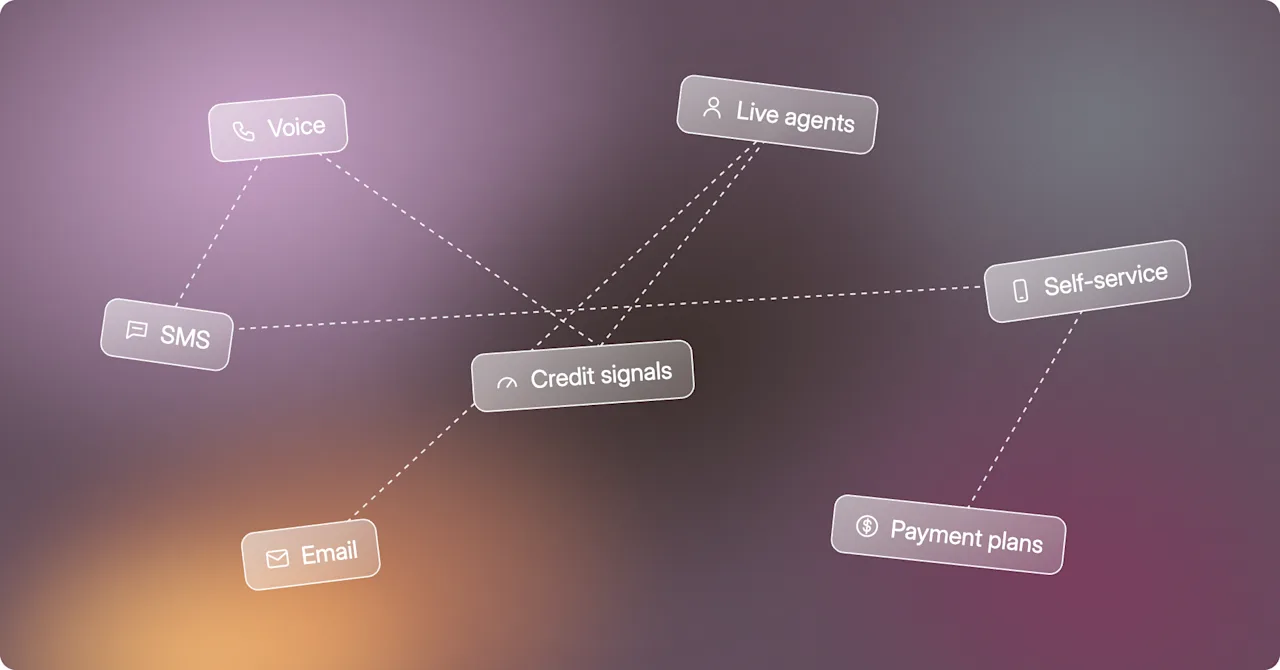
Is your collections stack a monster?
A dialer here. A chatbot there. An SMS vendor, an email tool, a letter vendor, a payment portal and a few agencies. Every one of them was added for a good reason: a new channel, a new regulation, a gap that needed filling fast.
But most collections stacks grew one tool at a time, and those tools were never built to work together. The result is what we call the Frankenstein problem.
The Frankenstein problem /n./ When collections runs on a patchwork of vendors and tools with no single brain deciding what happens next. Every part works on its own, so the whole thing lurches.
We hear about this painpoint all the time from collections leaders who reach out to us for AI collections solutions. Here's how it shows up for your team, your company and your borrowers, and what changes when one brain ties it all together.
Four ways a stitched-together stack keeps your numbers flat
Each tool in your stack may do its job well. The trouble lives in the seams between them. These are the four gaps that show up again and again:
Point solutions, not a system.
No single engine decides channel, message and offer together. You optimize the pieces while P&L impact stays flat.
Segment-level, not account-level.
Rules-based tiers treat every borrower in a segment the same way. That ceiling shows up directly in roll rates and self-cure numbers.
Compliance bolted on after the fact.
Manual QA can't scale with volume, and it's the first thing an examiner will ask you to walk through in real time.
Headcount that can't flex with volume.
When resolution depends on live agents, cost-to-collect rises in lockstep with delinquency, right when budgets are under the most pressure.
None of these is one tool's fault. Together, they explain why so many collections teams add vendor after vendor and still watch their numbers hold steady.
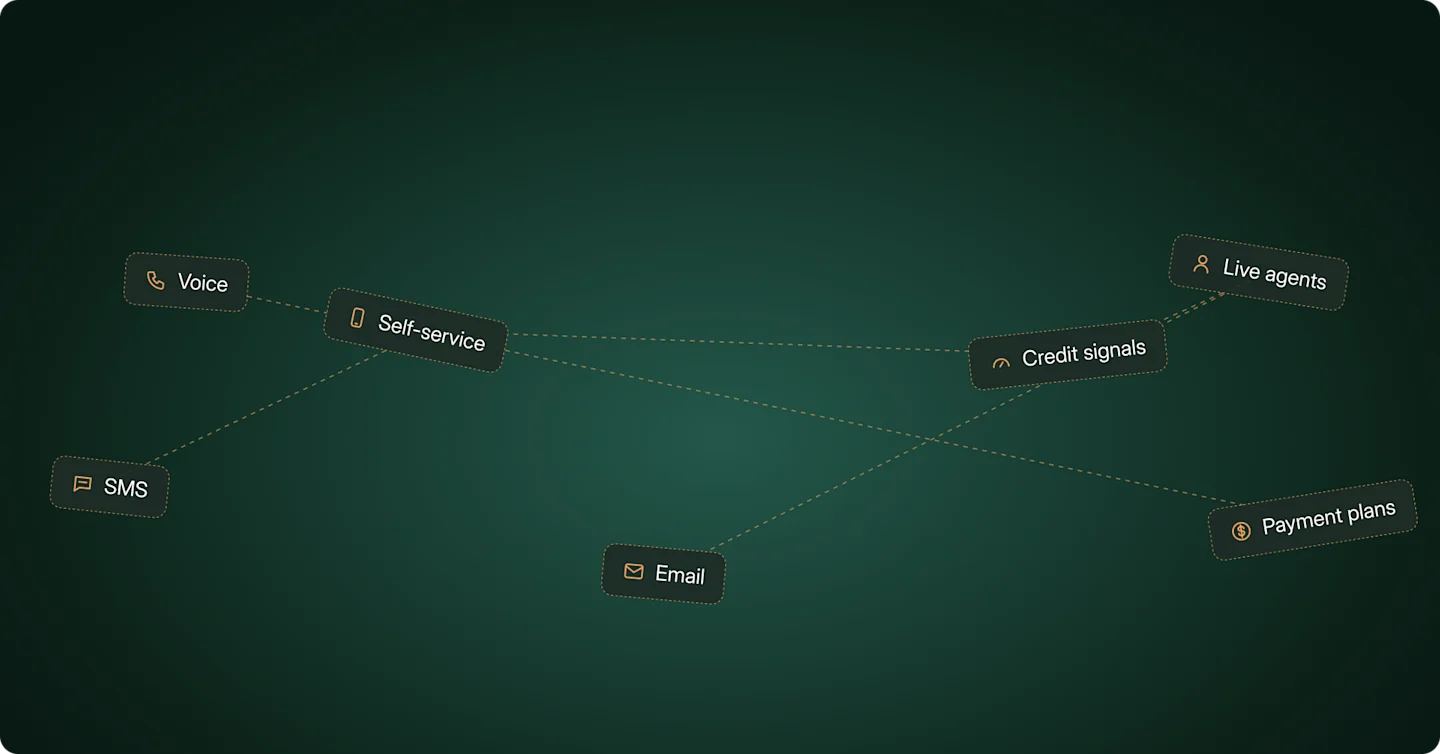
On the consumer's end, it can feel like hearing from five different companies
Meet Dana - a borrower. She fell behind after her shifts were cut, and she wants to fix it. Here's her week:
Monday, 8:02 a.m.
A missed call from an unknown number. The dialer calls while she's at work.
Monday, 12:15 p.m.
A text: pay $640 today to avoid further action. The SMS vendor can't see that her hours were just cut.
Tuesday, 9:30 a.m.
An email: good news, you qualify for a plan starting at $95 a month. A different tool, a different offer.
Wednesday, 7:48 p.m.
Dana tries to take the $95 plan through the chatbot. It can't see the email, so the offer is gone.
Friday, 10:05 a.m.
She finally pays through the portal on Thursday. On Friday, an agency calls about the balance anyway.
Every system did exactly what it was set up to do. But with no single brain running the conversation, the experience is disjointed and jerky. Contradictory outreach erodes trust and drives complaints and disputes, and it can lead borrowers who want to pay to tune out every channel. That's a recovery problem, a compliance problem and a brand problem at once.
See one recovery brain in action. Book a demo of our AI recovery engine, AiRE, and we'll walk you through how one engine decides who to contact, on which channel, with what message and offer, and where the seams in your current stack are costing you recoveries.
And the cost doesn't just stay in collections
A stitched-together stack doesn't just cap recovery. Each seam quietly creates work for another team:
CFO: Charge-offs stay stubborn and cost-to-collect keeps climbing.
Risk and Compliance: A dozen vendors to audit, and no single view of every message a borrower received.
IT: Every new tool is another integration, another security review and another quarter.
Procurement: More contracts, more oversight and more vendors to manage.
Brand and CX: Complaints and reviews to manage when messages overlap.
It's rarely one tool's fault. The cost lives in the seams between them. And as we saw with Dana, the person who feels it most isn't inside your company at all.
It's alive! What one recovery brain changes
The answer isn't one more point tool. It's a single omni-channel decisioning layer that orchestrates every channel, including your call center. It ingests credit, behavioral, voice and alternative data for every account and decides who to contact, on which channel, with what message and offer. Then it learns from every outcome and gets smarter with each interaction.
In plain English: instead of eight vendors each deciding on their own, one engine sees everything about an account and makes one coordinated decision across every channel.
The goal isn't replacing your people. It's knowing exactly when they're needed. Agents spend their time where a human truly helps, and every other account can resolve itself.
Here's Dana's week again, with one brain in charge. She gets one text in the evening, when she actually reads her messages, offering a $95 plan with a start date she picks. When she doesn't reply, the follow-up comes by email in a warmer tone, with the same offer. When she stalls at checkout, a voice AI call sets the plan to start after her next payday. By Thursday she's enrolled, every channel knows it, and no agency calls on Friday.
Meet AiRE
AiRE is Bounce's proprietary AI Recovery Engine. We built it in-house as one system, rather than stitching it together from third-party tools. It runs today across more than 50 creditor partners and over 2 million accounts.
Here's what Bounce partners have seen when they make the shift:
~19% reduction in charge-off rate in pre-charge-off portfolios
39% roll rate improvement (B1 to B2) for a personal loan lender
91% of interactions resolved without a live agent
+54% more right-party contacts per dialing hour
3.6x more value per collections hour
Figures are drawn from Bounce partner engagements and internal experiments (Bounce Labs, 2026). Results vary by portfolio.
Want the full story behind these numbers? See our 2026 AI case studies →
Ready to unblock your collections stack?
Before you add another tool, or sign your next AI collections contract, make sure you're fixing the model and not just adding more parts.
See AiRE in action. In a short, personalized walkthrough, we'll show you:
How AiRE decides who to contact, on which channel, with what message and offer, for every account
What a borrower's week looks like when every channel, including your call center, works from one view of the account
The results Bounce partners are seeing in charge-offs, roll rates and right-party contacts
Where the seams in your current stack may be costing you recoveries